Saturday, 16 February 2019

3 Things You Need To Know As You Prepare For The $100M Strive Masiyiwa Rural Entrepreneurship Fund.

3 Things You Need To Know As You Prepare For The $100M Strive Masiyiwa Rural Entrepreneurship Fund.


Image: fortune.com

Just about 2 weeks ago Dr Strive Masiyiwa consummated his Re-Imagine Rural Series on his facebook page with what I term the most bold patriotic statement of our time. Right in the comment section, as is the norm, he announced the 100m Fund set up for Rural Entrepreneurs ONLY.

I am in no official capacity to represent Dr Masiyiwa, nor his projects, but just an adept and staunch follower of his, who diligently jots down notes when he shares nuggets and his vision.

It's unfortunate that just after two weeks of the announcement being made, there are already myths surrounding it that need to be busted before the good news becomes food for scams and cheap politicking.
#1.The fund will be disbursed through Steward bank as loans NOT through individuals nor political parties. The post unequivocally states, "No political lobbying for support."
#2. The fund is from their(family I suppose) personal money.
#3. The fund will be disbursed as loans NOT "free" money (This is for entrepreneurs)
#4. The fund is for Rural Entrepreneurs NOT STRICTLY Agric entrepreneurs (there are thriving mining, logistics, manufacturing businesses in rural areas )
#5. Traditional business such as stores and grinding mills are EXCLUDED! Innovation and trans-generational thinking is encouraged.
#6. There is NO collateral required.

Let's delve straight to business. How can one start to prepare for this lifetime opportunity?

As aforementioned, the fund is to "fulfill my dream of #ReImagineRural" as Dr Masiyiwa puts it. So the first question should be What EXACTLY is this dream and how does the visionary think it should fulfilled? In as much as the vision will be laid out to those who will be accepted through a training program before they get the loan, one would need an urge to even get that opportunity in the first place and that is why I wrote this article. I also meditate on this series to sharpen my perspective as an Agricultural Engineer and a farmer.

What is the Re-ImagineRural Vision?

Dr Masiyiwa believes, "bringing innovative ideas to rural areas is one of the key frontiers of African entrepreneurship." He goes on to say, "We need to move on from the only source of employment being rural stores, butchers, and grinding mills...we need fresh ideas for tackling problems that have long been ignored by policymakers and entrepreneurs!"

Employment creation, innovation, underserved needs. These stand out for me.

Are you creating employment by introducing new, efficient approaches or technologies that addresses traditional and most pressing needs in rural areas? Are you solving drudgery(my goal is to eliminate the hoe and relegate it to the museum- who once said those words twice?), Is sanitation and lack of access to banking and markets an old problem, do farmers lose more than 40% of their tomatoes post harvest and can they earn more value if processed?


To ReImagine to have a relook at something and come up with different perspectives or approaches. Can you re-imagine Rural Banking, Communications, Education, Health, Land, Industries, Nutrition, Sanitation, Service Delivery, Support Services, Tourism, Trading, Transportation, Water?

How?

On the second article to the Re-ImagineRural series, Dr Masiyiwa elaborately narrates a story of how he attended the Gorilla-naming ceremony in Rwanda. The story captures, in detail, how Rural economies can be re-imagined. Through an inclusive business model which gave the community a stake in the tourism returns that resulted from the Gorillas in that area, the people of the jealously protected the endangered gorillas. It is my view that similar models that create value while impacting the society and the environment positively will be more encouraged.

It may be prudent to also to look at what the good doctor calls the People-Product-Process approach, which he covered in detail sometime back in 2017. In whatever business you have in mind, do you have the right talent, innovative idea/product and firm grasp of the process to raise money, build a business, manage cash flow, go to market, sell your product?

"Small big ideas" -Belinda and Julius!

One wonders NOW, how big should my project be and will "they" really look at my small efforts and reward them? There are a couple of wrong things about that question in my view. There are no small ideas! From my experiences on the Strive Masiyiwa page, there can only be emerging businesses that start small with great potential to impact people and nations. In his third installment of the Re-ImagineRural series, he gives an example of a "small big idea" he and his family were implementing at the time. The initiative, which he termed "an egg a day for under-fives" is basically that- giving under-fives an egg a day. It sounds small, huh? Till you look at the projected impact it has.

Belinda and Julius are not just random names I picked but just a few of the rural entrepreneurs who responded with proposals of their seemingly small yet big ideas and they got funding right away. What I found common in both ideas, is how the two articulated with simplicity their dreams, and how they were using traditionally known businesses to impact livelihoods in their communities. Also they had already started their ventures with little resources. They Re-Imagined poultry and the rest as they say is history(Not history as such but the beginning of their future).

Lets get our hands dirty and not wait or pin all out hopes on the loan. Instead lets begin to Re-ImagineRural Zimbabwe, Rural Africa and start NOW! If an investor should find no novelty, creativity or viability in your business, they should at least take another look at you and say, "but why does s/he believe in his vision so much that he uses his few resources on that vision."


3 Things You Need To Know At As You Prepare For The $100M Strive Masiyiwa Rural Entrepreneurship Fund.

3 Things You Need To Look At As You Prepare For The $100M Strive Masiyiwa Rural Entrepreneurship Fund.


Image: fortune.com

Just about 2 weeks ago Dr Strive Masiyiwa consummated his Re-Imagine Rural Series on his facebook page with what I term the most bold patriotic statement of our time. Right in the comment section, as is the norm, he announced the 100m Fund set up for Rural Entrepreneurs ONLY.

I am in no official capacity to represent Dr Masiyiwa, nor his projects, but just an adept and staunch follower of his, who diligently jots down notes when he shares nuggets and his vision.

It's unfortunate that just after two weeks of the announcement being made, there are already myths surrounding it that need to be busted before the good news becomes food for scams and cheap politicking.
#1.The fund will be disbursed through Steward bank as loans NOT through individuals nor political parties. The post unequivocally states, "No political lobbying for support."
#2. The fund is from their(family I suppose) personal money.
#3. The fund will be disbursed as loans NOT "free" money (This is for entrepreneurs)
#4. The fund is for Rural Entrepreneurs NOT STRICTLY Agric entrepreneurs (there are thriving mining, logistics, manufacturing businesses in rural areas )
#5. Traditional business such as stores and grinding mills are EXCLUDED! Innovation and trans-generational thinking is encouraged.
#6. There is NO collateral required.

Let's delve straight to business. How can one start to prepare for this lifetime opportunity?

As aforementioned, the fund is to "fulfill my dream of #ReImagineRural" as Dr Masiyiwa puts it. So the first question should be What EXACTLY is this dream and how does the visionary think it should fulfilled? In as much as the vision will be laid out to those who will be accepted through a training program before they get the loan, one would need an urge to even get that opportunity in the first place and that is why I wrote this article. I also meditate on this series to sharpen my perspective as an Agricultural Engineer and a farmer.

What is the Re-ImagineRural Vision?

Dr Masiyiwa believes, "bringing innovative ideas to rural areas is one of the key frontiers of African entrepreneurship." He goes on to say, "We need to move on from the only source of employment being rural stores, butchers, and grinding mills...we need fresh ideas for tackling problems that have long been ignored by policymakers and entrepreneurs!"

Employment creation, innovation, underserved needs. These stand out for me.

Are you creating employment by introducing new, efficient approaches or technologies that addresses traditional and most pressing needs in rural areas? Are you solving drudgery(my goal is to eliminate the hoe and relegate it to the museum- who once said those words twice?), Is sanitation and lack of access to banking and markets an old problem, do farmers lose more than 40% of their tomatoes post harvest and can they earn more value if processed?


To ReImagine to have a relook at something and come up with different perspectives or approaches. Can you re-imagine Rural Banking, Communications, Education, Health, Land, Industries, Nutrition, Sanitation, Service Delivery, Support Services, Tourism, Trading, Transportation, Water?

How?

On the second article to the Re-ImagineRural series, Dr Masiyiwa elaborately narrates a story of how he attended the Gorilla-naming ceremony in Rwanda. The story captures, in detail, how Rural economies can be re-imagined. Through an inclusive business model which gave the community a stake in the tourism returns that resulted from the Gorillas in that area, the people of the jealously protected the endangered gorillas. It is my view that similar models that create value while impacting the society and the environment positively will be more encouraged.

It may be prudent to also to look at what the good doctor calls the People-Product-Process approach, which he covered in detail sometime back in 2017. In whatever business you have in mind, do you have the right talent, innovative idea/product and firm grasp of the process to raise money, build a business, manage cash flow, go to market, sell your product?

"Small big ideas" -Belinda and Julius!

One wonders NOW, how big should my project be and will "they" really look at my small efforts and reward them? There are a couple of wrong things about that question in my view. There are no small ideas! From my experiences on the Strive Masiyiwa page, there can only be emerging businesses that start small with great potential to impact people and nations. In his third installment of the Re-ImagineRural series, he gives an example of a "small big idea" he and his family were implementing at the time. The initiative, which he termed "an egg a day for under-fives" is basically that- giving under-fives an egg a day. It sounds small, huh? Till you look at the projected impact it has.

Belinda and Julius are not just random names I picked but just a few of the rural entrepreneurs who responded with proposals of their seemingly small yet big ideas and they got funding right away. What I found common in both ideas, is how the two articulated with simplicity their dreams, and how they were using traditionally known businesses to impact livelihoods in their communities. Also they had already started their ventures with little resources. They Re-Imagined poultry and the rest as they say is history(Not history as such but the beginning of their future).

Lets get our hands dirty and not wait or pin all out hopes on the loan. Instead lets begin to Re-ImagineRural Zimbabwe, Rural Africa and start NOW! If an investor should find no novelty, creativity or viability in your business, they should at least take another look at you and say, "but why does s/he believe in his vision so much that he uses his few resources on that vision."


Thursday, 10 January 2019

Agriculture in Zimbabwe: The Road to Success

Agriculture in Zimbabwe: The Road to Success


As participants in all walks of the Zimbabwean economy steel themselves for what inevitably will be a challenging beginning to 2019, the enduring national smile, somehow, remains visible. Given that these are not the first fuel queues we have endured, nor the first price hikes we’ve begrudgingly swallowed, the general lack of confidence that things are soon to get better is perhaps understandable. Although we may shake our heads and wish for better, Zimbabwe still has a unique ability to ‘make a plan’. Clearly some of these plans are being implemented, because – against all odds – Zim trundles on, through what can only be described as a gruelling economic period.

A photo of fuel queues in central Harare (photo courtesy of GPSA)
It is an astonishing sort of resilience that finds positives in our current situation, and one for which millions of Zimbabweans deserve credit. Sun Tzu’s adage that “in the midst of chaos, there is also opportunity” seems improbable as we look with despair at the kilometres of hopefuls approaching every Puma, Zuva, and Engen in the land. But there is art to how Zimbabwe is approaching this war against its past, and encouragingly, its future seems to be winning. There is a palpable tension; an excitement for what is to come. Zimbabwe is ready to emerge from this arduous chapter, and to reinstate itself as a serious economy; a force with which to be reckoned.


Confusion still surrounds the practical changes that need to take place before this transformation can occur. Those of us involved with Zimbabwe’s agricultural sector know, on first name terms, the frustration of the mismatch between Zim’s potential and its current performance. Those in search of solace need to look no further than the tobacco industry, whose regeneration is the lifejacket keeping Zimbabwean agriculture afloat. From record lows of 48 million kilograms in 2008, tobacco output is once again in competition with itself, trying its damnedest to break its own annual output records. In 2014, the output was 217 million kilos. In recent years, output has hovered quite stably near 200 million kilograms. Happily, another figure instils confidence: for 2000’s output, 1,500 farmers were responsible for 97% of the crop; but for 2013’s output, that number soared to 110,000 contributing farmers (depending on whom you ask; some people’s figures are actually closer to 150,000).

Tobacco floor in Harare (photo courtesy of www.sundaymail.co.zw)
But there is only so much buoyancy, so much respite, that one industry within one sector can provide. The contract model followed by the majority of the tobacco industry (I think 80%) has been met with resistance by the old guard, but has unequivocally worked. Marmite: love it or loathe it; it still sells. So, what to do? How do we alleviate the burden currently assumed by tobacco sales and tapping Zimbabwe’s mineral and gemmological wealth?

Whether the contract model is replicable within horticulture and crop cultivation remains unclear. There seems to be uncertainty as to whether horticulture and crop cultivation can bow down to that venerable overlord of FOREX Generation. Quite how this uncertainty can be justified also remains – to me at least – unclear. In Zimbabwe’s most prosperous economic era, it went by a nickname that we are all keen to reinstate: The Breadbasket of Africa. Contract farming facilitates smaller players to farm in the same way as their more efficient and cashed-up big brothers, whose operations run at a level of profitability that allows them to invest in their own future. But they too once had limited resources, and in simple terms, what contract farming really means is that farmers of all scales have the same level of access to machinery and technology. Zimbabwe benefits from a near-perfect agricultural set-up: its climate, its soil, and its bottomless reserve of energy for remounting the pedestal of international trade render it one step away from realising a great potential. That step is mechanisation.

A World combine harvester for small-scale farming use. Currently available from Kurima Machinery.

It is at this point that I must apologetically plug my company, for what is an opinion piece without some shameless self-promotion? Kurima Machinery is at the forefront of empowering the smallholder farmer through considered, intelligent mechanisation. Where previous players in the small-scale farming world have focused on selling a machine and washing their hands of their clients, Kurima recognises that its responsibility does not lie solely with the importation and sale of complicated machinery. Two fundamental elements of selling farming equipment have been overlooked too frequently, namely: training; and servicing. The former is essential. Not only must a buyer fully understand how to operate their machine (the full usefulness of a machine can only be realised when it is used fluently and efficiently, otherwise it can be actively counterproductive); but a buyer must be helped to understand the benefit of the upgrade they are undertaking. Explaining – in simple, clear terms – how an initial capital outlay can generate increased returns will make sure the new technology is fully adopted; that the investment benefits the investor; and, in time, that the agricultural sector is able to perform to its full potential.


Encouragingly, Kurima is not alone in its desire to change the way the small-scale farmer is treated. From the dark days of lending, with unrealistic repayment terms, unreasonable interest rates and punitive default charges, some pioneering financial institutions have seen the light. Success Microfinance, to name but one, certainly seems to have understood that the income of their typical client is limited and sporadic; that their spending patterns follow their earnings, almost to the hour; and that taking 10 hectares of land in a remote rural area as collateral benefits absolutely nobody. Without giving away too much of Success’ secret to…well…success, take it from me and some of the clients who have benefitted from their services that their terms are realistic; their interest rates are favourable (excellent, in fact); and that their ambition is not to repossess all smallholder land in the country, one collateral hectare at a time. They, too, have the future in mind.

I, for one, have faith in Zimbabwe’s ability to regenerate. As long as the same slap-dash, quick-fix approach that is applied to road repair in Harare is not applied to rejuvenating agriculture in this country, I see only good things on the horizon for farmers. The potholes created in the road to success by ineffectual farming cannot simply be filled in; we must repave the entire road. And for that, we’re going to need a few machines.


--> Ferdinand M C Reynolds Commercial Director: Kurima Machinery and Technology
+263779104809
www.kurimamachinery.com

About the author:

Ferdinand Reynolds has recently moved to Zimbabwe from the U.K. to join the team at Kurima Machinery. He is a recent graduate from Balliol College at Oxford University, where he read for a degree in Spanish and Italian. He is enjoying Zimbabwe a great deal, and would welcome any questions or comments!

Thursday, 13 December 2018

Imported Preowned Cars Are Not The Future! 2 Wheel Tractors Are!


Zimbabwe requires about 30000 tractors, an average cost of $1,2 billion, to productively utilise its arable land. At our best, it can take a century meet that target. The reasons often cited for this deficit include lack of capital by farmers and inadequate government support.

On the other hand, Zimbabwe has shelled out more than $3 billion worth of vehicles over the past 9 years, a third of which went to economy cars from Japan. The average landing price of an Ex-Japanese car is about $4000 and the average owner is the common man who earns below $600 a month.

A simple analysis of these numbers suggests that Zimbabwe has more of a priority  problem than a money problem!

Agriculture contributes about 18% of the GDP of the nation and employs more than 65% of its people. Evidence has shown that growth in agriculture is up to 11 times more effective in reducing poverty than growth in any other sector. As the country is faltering at the brink of economic collapse, much of its challenges are attributed to lack of productivity in the economy. With some of the best soils in the world, vast underutilized land and arguably the most literate people, one would expect to find importation of farming machinery on the top of the list. Alas, it's one of the last.

Let me hasten to disabuse the common myth that says a car is an asset. It is not, unless one uses it to generate an income! Let alone a pre-used, fuel inefficient vehicle. It's largely a liability to the owner and the country as well- more than $100million worth of spare parts spent per year and high demand for fuel. An asset brings an income and that's what a tractor does! Just as we have economy cars, we also have compact, economy tractors. For the price of one Toyota Vitz, one can buy a two wheel tractor with ploughing and planting implement.

Not all people are farmers, true! But all people need to be productive and generate an income. This is what a tractor can do, both as a piece of machinery that makes use of idle land to feed the nation and as an asset that can be hired out to farmers as a business. In about 2 years one is sure to generate a surplus to what they invested in purchasing the tractor.


What is this two wheel tractor(2WT) I have been touting? It's a two wheeled version of the conventional tractor that can be used with various implements for ploughing, planting, harvesting, shelling, transportation, trench digging and even water pumping. It's simply a power source for a host of farm operations. Some call it a walk-behind tractor but with the right attachments, one can actually sit while operating it.The average cost in Zimbabwe is $2500 USD.

China, where we buy bulk of our weaves, gadgets and clothes, manufactures these tractors and lots of other farming machinery. Bangladesh, one of the biggest beneficiaries of these 2 wheel tractors, was a basket case in the 70s but as of 2010, 80% of all tillage activities are now mechanized and 75% of their wheat production is done by 2WTs. They have imported more than 300 thousand 2WTs, for every 30 farmers they have one 2WT owner(rural entrepreneurs) servicing the area. The importation of these tractors has fermented a lot of entrepreneurial activities, especially manufacturing and engineering services.

Credit: FACASI

Investment in machinery like the two wheel tractors ensures maximum utilization of our land and food security, creates jobs and business opportunities, reduces drudgery and channels labour to more productive uses, reduces the cost of production of food and ultimately the prices and cost of living. It takes a day to do 3-5ha of tilling, planting and fertilizer concurrently. One person does in a day what 4 people used to do in six to ten days.

Purchase of one 2WT directly benefits 30 farmers; we have about 1.5 million smallholder farmers meaning 50000 2WTs will do. This is less than a quarter of the money we spent on Ex-Jap vehicles over the past ten years which we have nothing to show for anyway except a ballooning fuel import bill.


Rationality in economics demands that when one has limited resources, they should spend them on goods or services that bring the highest level of satisfaction. We can extrapolate that same principle to say it is highly irrational to borrow for the purposes of satisfying a want/luxury instead of a need(in our case, to produce).

In the same way that we mobilize resources through debt and savings, we should channel these resources to more productive endeavors. In the same way we do konde konde and stokvels for groceries and kitchen top-ups for utensils, why are we not doing the same to buy productive machinery and we wait on government? For crying out loud, farming machinery is duty free. If all of us can be vendors, we can as well be involved in agriculture! We have the land!

I am under no illusion that importation of these machines is the single panacea to the chronic economic woes bedevilling our nation. But I bet my last dollar, if we had more tractor/farm machinery sales than car sales, we would have had less problems. If we had more tractor loans than car loans, our future would have something to show for the debts and interests we paid. It would be a more progressive culture to celebrate purchasing of machinery than of trinkets and a much better picture of how we are working towards eliminating the relic of servitude our countrymen go through to produce food.

Monday, 17 September 2018

The much awaited Review of the Modernage Multifunction Machine Video


Above is the video of a review done by Engineer William of Multipurpose motorised tilling machine which promises to revolutionize the way we do farming in Zimbabwe.


An in-depth technical analysis is done on performance, capacity, reliability, ergonomics and cost of the machine to help farmers understand their investment.


Enjoy and share your thoughts.

Thursday, 6 September 2018

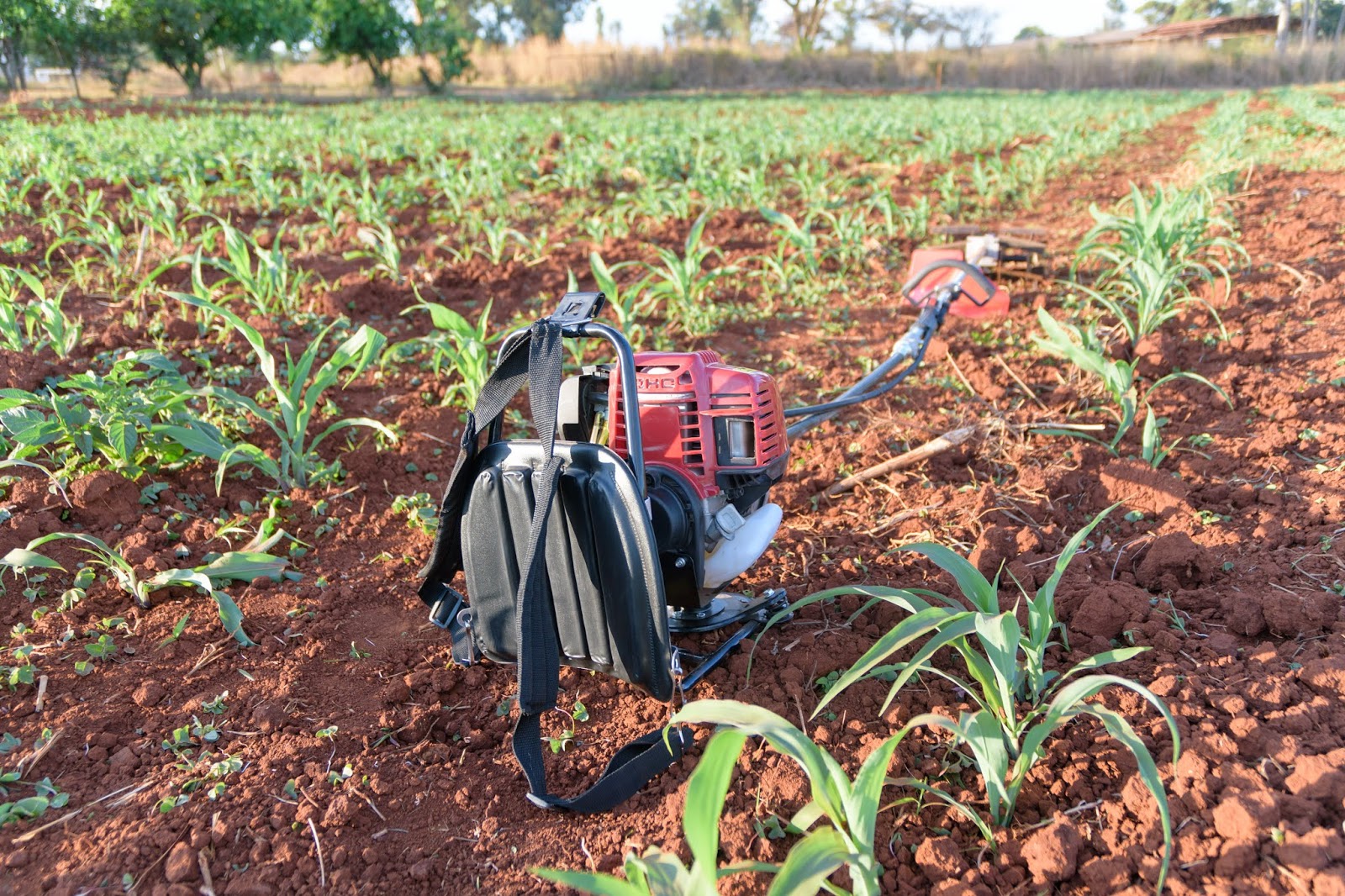
Review of the Modernage Multi-Function Machine


In the words of the former chairman of the African Union, Dr Nkosazana Zuma,"The hoe belongs to the museum!" This is a statement of fact! Using the hoe, especially for weeding and cultivating is the single most gruelling, costly and time-consuming field  process in agriculture. To add salt to the wound, our women are the most affected by this relic of servitude.

In search of a better solution on our local market, we found something that promises to revolutionize the way smallholder farmers do their tillage. The Modernage Multi-Function Machine(MMFM)! Whether it lives upto its name, well we took it to the Institute of Agricultural Engineering to find out.

Every piece of mechanization worth its salt exhibits exceptional technical capacity, performance, reliability and most importantly cost effectiveness. We chose heavy red clay soils to test the machine's capacity and capabilities.

The Modernage Multi Function Machine is indeed versatile- Put on your weeding blades and you have a weeder, put on your rotary knives, it becomes a cultivator and put on the cutting disc and you have your grass cutter. The aforementioned implements come as as one package. The MMFM can host a number of implements including pumps and tree cutters as well.

Click here for the video review of this machine

Reliability and Specs

The machine comes in two engine types; The red Honda 4 stroke engine and the green one of the same power rating but a different manufacturer. The former has a comparably lower fuel consumption rate and a 2 year guarantee and thus a higher price. The green one has a 1 year guarantee and costs less. Guarantee is now such a rare offer but what more can we say if the supplier has this much trust and for that we give it a 8.5 out of 10 for reliability and durability.


Technical Performance

At 1.5horsepower the machine finishes a hectare in 21 hours as compared to 184 hours on manual labour. So it takes nine times less time or it does the work of 9 humans at once. The rotary blades and cultivating blades removed all the weeds loosening the compacted soil while creating a level aerated bed. On dry grass, the cutter cruised with speed, leaving a clean trail. The machine consumes from 1-1.3litres in an hour, making the overal cost almost equal to that of tractor doing the same work. However, having an aircooled engine, makes it prone to heating up after a couple of hours of continual use.. On Technical performance the microweeder deserves an 8.

Ergonomics


 You may ask, Who can use the tool? - Answer is every one that can carry a 5 kg bag. so to put this to test we had a woman to demontrate the machine's ergonomics. With easy she ignites the engine, and in a split second a force equavalent to sixteen hoes beating at once is transmitted to its steel blades. A safety guard blocks away the dust and debris.
The long handle enables the operator to work in a relaxed position.The lady who operated it could not hide the joy and relief she felt after using it. In her words "Once the blades engage the soil, the machine effortlessly propels itself forward, all you have to do is direct it" That sealed it for us. 10 for ergonomics.

Cost Economics

Of paramount importance is the economics the machine. The purchase price for the green one is $450 and $750 for the red one with guarantees of 1 and 2 year respectively. Operating costs are 60% lower than conventional methods, saving about $80-120.per hectare on labour.

Considering the targeted market of smallholder farmers, the machine appears to be pricey but good machinery management can optimize the cost. The farmer can also earn about the same amount he saves through hiring out to other farmers, essentially turning it into a business. Through this model, after about 15ha, the farmer can raise the same amount he invested in buying.

The MMFM eliminates some hidden costs which we call the timeliness costs. These are costs or decrease in value of produce due to delays in carrying out a tillage process. If a farmer owns a machine like this, he/she doesnt have to wait for the availability of labourers and he takes about a tenth of the time using manual labour.

Good machinery management can reduce the effects of the initial costs and thus we give the machine a 7 on cost effectiveness.


After a day's with this machine, I can safely say the machine lived up to its reputation. It displayed exceptional power and ability to do its work.  This is a quantum leap towards the future of farming,just as the hoe was the the champion of the iron age. Despite the purchase cost being a bit high, the longterm benefits outweigh the initial investment. In one go, you can replace the hoe, the plough and save your precious time.

Watch the video for the review . Click here for the video.


Saturday, 25 August 2018

The Institute of Agricultural Engineering in Zimbabwe


The Institute of Agricultural Engineering (IAE) is a branch of the department of Agricultural Mechanization within the Ministry of Agriculture, Mechanization and Irrigation development.

Background

Farm mechanization dates back to 1912 when the first tractor (Fairbanks-Morse) was imported into the country. By 1947, the number of tractors in the country had increased to 1,155 rising to 3,448 and 12,115 tractors in 1949 and 1961 respectively.A Standing Committee on Agricultural Mechanization (SCAM) was established in 1962 to spearhead rapid agricultural mechanization. A farm machinery training centre (FMTC) was established at Domboshawa in 1964 and later renamed the Agricultural Engineering Training Centre (AETC). The SCAM established the Institute of Agricultural Engineering (IAE) whose responsibilities included research, development and adaptation of imported machinery to local conditions.O

These institutions were mainly geared towards offering support services to the Large scale farmers but today the primary mandate addresses the smallholder farmers needs exhaustively. The target group includes all farming sectors, manufacturers and service industries, small rural repair workshops and various government departments.

The work undertaken by the Institute is divided into two key areas;

  1. Research, testing and development
  2. Training


Currently the Institute has a staff compliment of just above 100 who include engineers, technicians, artisans and nontechnical staff. All committed to the research and development and promoting of technologies and technique for enhancing sustainable food production.

The IAE comprises six key sections which are expounded on below.

1. Farm Power and Machinery

To conduct research, testing, development and training activities on agricultural mechanization technologies and practices to improve agricultural productivity in all farming sectors.

2. Soil and Water Conversation

Improved management of natural resources through provision of research and extension services in soil and water conservation technologies.


3. Post-Harvest Technologies

To contribute to food security, profitable and sustainable productivity through the provision of effective research, testing and development in postharvest technologies of durabke and perishable crops.

4. Farm Structures

Research and development of farm structures such as greenhouses, tobacco barns and other production, procesing and storage structures.

5. Training

To provide effective training in agricultural machinery operation and maintenance and animal draught power and rural technology.

6. Irrigation

The Zimbabwe Irrigation Technology Centre, whose objective is to test and provide and provide irrigation regulation standards as well as research, is under the IAE.


As alluded to earlier, the Institute plays a key role in promoting the adoption of techiques as well as technologies that ensure sustainable farming interventions. Currently, the IAE in collaboration with Food Agriculture Organization(FAO) and CIMMYT in developing and promoting development and adoption of Conservation Agriculture(CA) machinery. The Conversation Agriculture agenda is being pursued to ensure sustainable tillage practices that conserve the soil as the key resource and also improve productivity.

The introduction of CA machinery has its own challenges. End users require skills to set, operate, calibrate and maintain the equipment and the Institute has been fulfilling that role. The various CA machinery and hands-on training will enable farmers to make informed choices on the type of implement they can use within their circumstances.

This is just a highlight of what the IAE has been able to accomplish with just government and a few other external funders. With a bigger Research and Development budget, The Institute is capable of becoming a pillar of technology development and knowledge transfer centre for Zimbabwe and the region as it houses some of the best minds in agricultural engineering in Africa.

Tuesday, 14 August 2018

Farm Machinery Senior Class: Owning vs Hiring


In my last article we touched on technical details on estimating the true cost of a machine. The fixed and variable costs in order for a farmer to look at machinery investment beyond just purchase price. Now, besides the cost structure, there are also other factors that need careful consideration in evaluating farm machinery decisions: both technical and not so technical.

Ownership vs Hiring.

Should one own farm machinery, if they have an option to evade the ownership costs and just incur operating costs? Yes and No! There are hidden costs that are associated with depending on machinery that you do not have absolute control over. Some hidden costs can be quantified for example timeliness cost.

Timeliness Cost.

When one owns all the machinery for his tillage and harvest operations, he has control over the scheduling and deployment. Timeliness cost is the value of field losses incurred due to delays in carrying out certain farm operation. For instance, for every day delayed in harvesting wheat, one loses 50kg per hectare planted.

Advantages of Custom Hiring

The machine comes with an operator. That means that the hiring farmer has no responsibility for operating or maintaining the machine. Also, the farmer can perform other tasks such as hauling and unloading grain while the combine is operating, without having to hire extra help. This is an important advantage for farmers with a limited labor supply.

There is no long-term capital investment in the machine. The cost of custom hiring can be paid from operating capital. There is no responsibility for liquidation of the machine if production practices or farm size change and it is no longer needed.
The farmer pays only for the number of acres actually servicedserviced and the custom operator's machine is more likely to be a recent model and in good mechanical condition.

Custom hiring also may have some disadvantages, but their severity will depend on the local situation.

Disadvantages

There may not be a competent operator and machine available nearby.
The hiring farmer will not be operating the machine and will not have complete control over the quality of the job performed.
The custom operator may not be able to harvest or spray the crop when it is convenient for the owner nor during the optimum time period. Problems could arise if the weather is bad and the custom operator has several other farmers waiting. A schedule or priority list needs to be worked out ahead of time.

The strengths of hiring are the weaknesses of ownership and vice versa. So, the question ceases to be just which one is better than the other, but rather how can I make ownership of equipment as less costly and more profitable as hiring? How do I retain control while using the equipment safely enough to reduce the ownership costs per acre?
The best way to do that is to estimate how many acres you can hire out your equipment so that you earn an income that goes to pay your insurance, housing, interest and depreciation expenses.

Joint ownership allows responsibility for investment, repairs, and labor to be shared with someone else. Joint ownership may generate enough use to make owning a machine profitable when it would not be profitable for one owner alone. However, cooperation is absolutely essential for all involved parties.

Click this link to access the article on the cost structure for owning farm equipment

Thursday, 2 August 2018

Farm Machinery Senior Class: Budgeting and Selecting


Investing in machinery at a farm is a major decision REGARDLESS of scale of the farm! Think of buying snow graders for road construction for a non-snow country? Investing in machinery is not only about one affording the shop price but whether it's economic for the farm. This article is about making smart decisions about how to acquire machinery, when to trade, best capacity to invest in.

First things first. One must know the best machinery for the purpose. The key operations that require machines are tillage,planting, weed and pest control, harvesting. Tillage implements prepare seedbed, destroy early weed growth. Planters ensure consistent spacing of seed and appropriate application of fertilizers. Harvesters reap clean and undamaged grain while minimizing field losses. Performance of machines depends on skill of operator, weather and soil conditions.

Machinery Costs

Machinery costs consist of Ownership and Operating costs. It is not about the dollar figure but minimizing the cost per acre, and reducing the ratio of cost per acre to sales per acre.

Ownership/Fixed Costs

These include depreciation, interest, taxes, insurance, housing or shelter for the equipment. These costs do not change as the machine sees more use. However fixed costs per work done decrease as the hours or acres worked increase. For example,the same machine that pays $400 per year, costs less if it does more work because it generates the money that pays the costs. These costs increase with size of machine and investment>bigger machine, bigger housing, insurance.
Principle: Buy machinery that does a lot of work for the farm or has less downtime.


Interest and  Depreciation

The lender determines the interest. But if you use your own capital to purchase machinery, the rate depends on the opportunity cost for capital elsewhere in your business. Inflation reduces cost of capital since loans can be repaid with cheaper dollars.

Capital recovery is the money that would have been set aside each year to repay value lost due to depreciation and paying interest. Another important term is the salvage/scrap value- the estimate value of the machine at the end of its useful life. Depreciation becomes the difference between the initial value and the salvage value, then divide it by number of years between purchase and salvage(economic life of machine, taken to be between 10_15 years). Interest is calculated as a percentage of the average value of the machine, which found by adding the new price and salvage value of the machine and then dividing by two.

Housing and Insurance

Insurance allows for replacement in case of disaster such as fire. An uninsured risk disadvantages the whole farm business. Properly sheltered equipment has lower depreciation rate and higher salvage or trade in value as well as less repairing costs. For simplifying Are calculated as 1% of the sum of purchase price and salvage value.
Principle: Insurance and Housing costs secure the machinery investment reduce other costs.


Operating/Variable Costs

Include Fuel, lubricants and repairs.Operating costs per acre change very little as machinery size change. Using larger machinery consumes more fuel but this is offset by the fact that more acres are covered per hours. Thus operating costs are of minor importance when deciding what size of machinery is best suited to a certain farming operation.


Repair and Maintenance

These depend on soil type, climate and vary from farm to farm depending on management policies and operator skill.  The best way to estimate your repair costs is your own past experience .

Fuel and Labour

For fuel costs, the easiest way is to use the standard fuel consumption rate for that machine per acre and multiply that by cost per litre to get cost per acre. cost per acre is then multiplied by the acres to be covered over the year to give total cost of fuel per year.

Adding all these costs gives you an idea of what your farm machinery investment is. Suffice to say investing more than you get per year is equivalent to economic suicide.  Another rule of thumb is that the total annual cost,(both operating and ownership) will usually be about 25-30% of the purchase value of the machine.

Let me categorically mention that the method I submitted above is only an estimation. The decision to buy machinery invariably involves the assessment a wider range of factors. Many of which are not quantifiable for instance, machine breakdown risk, timeliness costs, health and safety, comfort and easy of use to mention a few. One other thing: for large sized farms, as machines become larger, the cost per acre diminishes as shown on the graph below.

 I hope this information will add a little more objectivity in your machinery investment decisions. Put your questions in the comments box and lets have a conversation.

My next article, I will present a simple worksheet for the above estimation methods as well as standard rates in our Zimbabwean context. Let me know other areas that interest you around this topic.